
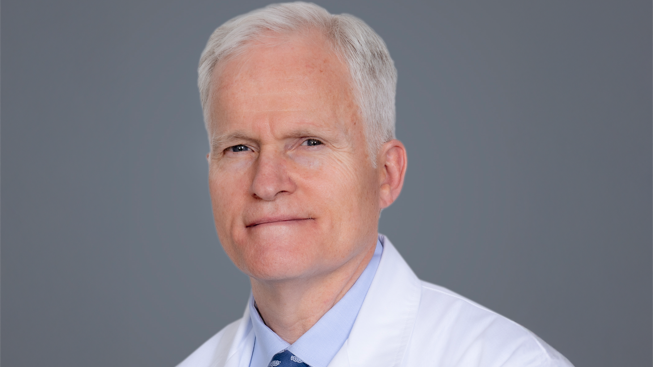
On January 1, 2026, John R. Crockarell, Jr., M.D., M.B.A., took the role of Campbell Clinic Chief of Staff, succeeding Frederick M. Azar, M.D., who has served with distinction in the role for sixteen years. Dr. Azar was recently appointed to serve as the University of Tennessee – Campbell Clinic Department of Orthopaedic Surgery and Biomedical Engineering Harold Boyd Chair and will continue to see patients and contribute to Campbell Clinic’s mission as a physician and partner following the transition.
Dr. Crockarell has served on the Clinic’s Finance, Quality, Patient Care and Education committees and on the Campbell Clinic Foundation Board. We sat down to ask him a few questions about leadership, education and life outside the clinic.
Describe your practice?
I completed the UTHS-Campbell Clinic orthopaedic surgery residency in 1996, after finishing medical school and an internship with the University of Tennessee Health Sciences in Memphis. After fellowship, I returned to Memphis to practice in 1997. I subspecialize in lower extremity adult reconstruction (“total joints”). Currently, I see patients at the Collierville, Wolf River, and “old” Germantown Clinics.
How have you been involved with the Campbell Clinic Foundation?
I have been involved in resident education throughout my career. With outstanding support from the Foundation staff, our adult reconstruction division has enjoyed a significant increase in research studies over the last decade, including bread-and-butter projects like retrospective reviews, gait analyses, and randomized clinical trials.
What advice would you give to future surgeons and early career surgeons who are entering the orthopaedic field?
To future surgeons–My advice would be to find a patient population that you love and never stop serving them. I believe that if you’re a surgeon at heart, you can find satisfaction within a variety of subspecialties in the orthopaedic world. What sustains you when your practice grows and other responsibilities and challenges take more of your time and attention is the impact on and gratitude from long-standing patients who have been on the journey with you over the years.
For early career surgeons–My advice would be to try and maintain some margin in your life. When I was a younger doctor, I didn’t know when I was trying to do too much until I was doing too much. Having said that, my family was quick to let me know when I was overcommitted and needed to scale back. Establishing rhythms that prioritize faith and family keep a younger surgeon grounded and able to withstand the challenges that come from a surgical practice.
What is the role of Campbell Clinic as an academic center?
Research and education are of paramount importance and have been throughout our history. Training the next generation of surgeons sustains our [orthopaedic surgery] specialty and offers hope to patients that come through our doors. Research refines treatment options for them so that they can receive the best care possible and enjoy a better quality of life.
Another side of being an academic center involves accepting and treating some of the most challenging medical conditions, injuries and diagnoses. As subspecialized as we are, we owe it to patients to help them regardless of where their care originated. Sometimes this involves multiple disciplines, subspecialties and career stages. To me, this [collaboration] is the pinnacle of what we are called to and blessed to be able to do.
How do you juggle a demanding practice, research and leadership?
Now that I’m 60, I eat less, sleep less, and can’t play sports like I used to, which leads to time for other things. As stated earlier, my family keeps me grounded, my grandkids keep me young, and my faith helps it all make sense. My grandchildren are my joy, and they couldn’t care less about my day job! My wife, Jodie, is my exact opposite: it is such a blessing she and I truly complement each other in virtually every category!